Sunday, February 15, 2015

A History of Religion in 5 ½ Objects


The first sermon I ever gave  at the Unitarian Universalist Church of Augusta was about the theological and spiritual functions of film. I remember talking about a Catholic understanding of sacrament, that through material objects we can glimpse the sacred. While I taught theology and religious studies in the United Kingdom, my specialism was theology and film, and an American postgrad student at Glasgow University once came to a seminar I was leading on the topic. His name was Brent Plate, and he went on to teach and also write on the topic of film and religion. In fact I wrote a chapter for him in his book on the Mel Gibson film, The Passion of the Christ.

I have been fascinated with a book Brent recently published that looks at five types of objects that “humans have engaged and put to use in highly symbolic, sacred ways” (A History of Religion in 5 ½ Objects, Beacon Press, 2014); these objects are ordinarily common, basic, profane (profane Latin roots pro and fanus = outside the temple). (Plate, 4) “Such is the paradox of religious experience,” he writes, “that ordinary things can become extraordinary.” (4)

To explain this we need to think about how the primary contact points between the self and the world are the sense organs: mouth, nose, eyes, ears, skin. The Greek philosopher Protagoras said that a human “is nothing but a bundle of sensations”. (5) The poet Dianne Ackerman says that our senses are the primary place of communion with the physical world.

Religion, then, is deeply sensual, and this statement may come as somewhat of a shock!

But Brent Plate says that “too often religion is explained as a set of beliefs, which primarily exist in the thought processes of the brain.” And so we relegate symbols, rituals and even human bodies to be “merely secondary expressions of some primary intellectual order”. But, Plate claims, “there is no thinking without first sensing, no minds without their entanglement in bodies, no intellectual religion without felt religion as it is lived in streets and homes, temples and theaters.” (7)

Religion, being a prime human activity throughout history, is rooted in the body and in its sensual relations in the world; Plate says it has been and always will be. Any religious history is incomplete if it ignores the fact that “religion derives from rudimentary human experiences, from lived, embodied practices.” (14) So “to learn about religion we have to come to our senses”! (8)

We can’t talk about using our senses in abstraction: we know that it’s impossible to smell without an odor, to hear without a sound. The Walt Whitman poem “There Was a Child Went Forth” is about the child who engages with objects and these become a part of him as he grows: the first object he looked upon, that object he became…and the objects we engage in in religion are speaking to us and making meaning for us. (10) Objects have power – MIT professor Sherry Turkle says that objects help complete us. (13)

Nature is all around us – and we have needed to survive in the natural world by using things like shelter, fire, agriculture, the Internet – “our existence depends on our technological taming of nature, and that has led to a loosening of the connection between us and nature.” Religion has always interacted with the world in which we live, but we are creators and creations of culture to the point that we dismiss the role of nature when we proclaim our theology, despite the evidence of our own religious practices. One year in the Progressive Religious Coalition there was a discussion about pagan involvement in the Martin Luther King service; paganism was understood by some people as idolatry because they had problems with the idea of nature worship.

It was an irony lost on them, because when you think of the calculation Muslims make for prayer times, they are based on the time of day: pre-dawn, noon, afternoon, sunset, evening. The month of Ramadan is based on the visual sightings of the crescent moon. The Christian festival of Easter is determined - the first Sunday after the full moon (the Paschal Full Moon) following the March equinox. 

Culture is basically the cultivation of nature, and religion is one of the key ways humans have cultivated it. Each of the objects Plate writes about begin embedded in the natural world but through their interactions with humans and their senses they become part of culture. And this nature-culture nexus is also the birthplace of art. (18) Natural and man-made materials are repurposed for religious uses: rocks into sacred stones, wheat into bread for communion.

People who practice religion don’t necessarily know about the historical elements of that religion, but they know how to do that religion. Plate comments that religious people are not believers so much as ‘technologists’. Religion uses physical objects like stones, incense, drums, bread, and crosses in a technological way, and by using religious language gives them meaning.

So, given the connection between nature, culture and religion, let’s look at the elements we’ve used in this service:

The Cross
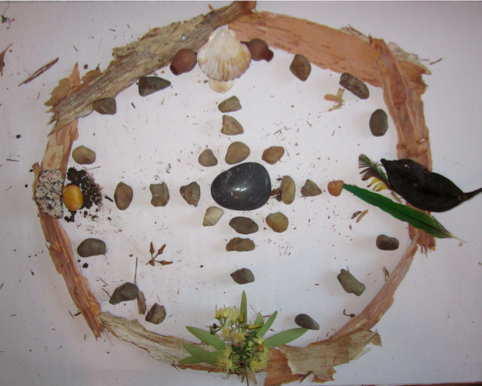
Intersection, division, or transformation – which do you think of first when you see 2 crossed lines? For abstract painters like Mondrian and minimalists like Agnes Martin, the grid, a series of intersecting crosses, was the most primal image that shows us the fundamental connection between nature and culture, human and divine. Crossed lines are not just limited to the Christian cross – as you saw at the opening calling of directions, the cross is much more ancient, and broader, in its metaphorical meaning. In it we can see two opposing forces - vertical and horizontal, heaven and hell, feminine and masculine, these are equivalent dichotomies that connect to it.

Brent Plate says that the “cross is a piece of technology that provides a bridge and allows connection. Through that association comes transformation. We cross over, crossbreed, cross-pollinate, cross-dress, crisscross “ (140) – all actions that leave us different than before. But visually, the place where the lines meet, the crux of the meeting spot, is where our eyes are drawn, to the unification of matter. That is the center, the fifth direction – there can in fact “be no directions without a grounding point”(145)

The Christian cross symbolizes transformation; the monstrous nature of crucifixion meant that Christians didn’t begin to use the cross as a symbol until a couple of hundred years after the death of Jesus (153).  There were earlier symbols like the fish or the term ‘the good shepherd’.

When the emperor Constantine saw a vision of Christ it was accompanied by a cross of light. The old Christian hymn “Onward Christian soldiers, marching as to war, with the cross of Jesus going on before” reminds us of the Crusades and other wars where crosses and swords went hand in hand. Of course nowadays the cross is a fashion item, a token of identity, worn around the neck, tattooed on bodies.

We would agree that the most monstrous cross of the modern world is the Nazi swastika, but it is an ancient Sanskrit image signifying happiness, and the term means good luck or good being. But its cooptation by Nazi Germany and today’s anti-Semitic extremists voids for us any redeeming symbolism…Brent Plate reminds us that ‘symbols seldom obey the limits of nations, cultures, religions, or languages’ (157).

Drums


The drum has a beat that is more than a metronome; it’s used in various religious traditions to “invoke the gods, protect people, create rain, unite communities, even bring people to the point of ecstasy” (100). From Shiva, the Lord of the dance for Hindus, to Icanchu, a birdlike creature who according to the Mataco people of Argentina, helps to recreate life in a world destroyed in a cosmic fire, the drumbeat is essential to the existence of people and the drum is another technology for living.

Shamans, like the Samis in Lapland, and the Yoruba of west Africa, use drums as the primary means of communication with the divine. Rituals in Japan’s Shinto shrines and Buddhist temples developed the modern kodo style of playing various drums together.

But there is also the therapeutic aspect of drum-playing that brings it into the realm of divine play, in the sense that play is an essential element of animal and human life. Stuart Brown, a psychiatrist, says that “We are built to play and built through play. When we play, we are engaged in the purest expression of our humanity, the truest expression of our individuality’ (134).

Incense

The cross - Visual, the drum - aural, and now the ‘scentual’: the “ancient machinery” that is the olfactory nervous system connects to the amygdala, triggering what some researchers say is the strongest emotional response out of human sense perceptions. Incense is called the food of the gods, and we all know the story of the gifts that the Wise Men brought to the baby Jesus – gold, myrrh and frankincense. If holiness has a scent then it is frankincense, burnt in the ancient Babylonian temple of Baal at the rate of 2 ½ tons every year. It was specified in a recipe God himself gave for incense to be used for the Ark of the Covenant in the book of Exodus (see p. 66).

But the burning of incense, besides the smell, is evocative due to the curling of smoke that is visually pleasing. King David sand about how the smoke rises to the heavens above: “Let my prayer be counted as incense before thee, and the lifting up of my hands as an evening sacrifice” (Psalm 141) Smoke is visible and yet not touchable, Brent observes, so in that sense is mystically seen but not possessed, just like light.

Incense has had a mixed reception in the history of Christianity; Christians moved away from the religion’s pagan and Jewish roots, both traditions that use incense. St John Chrystosom even declared, “God has no nostrils.”  The theologian Origen said in the 3rd century that one easy way to distinguish Christians from pagans was the burning of incense (72). But by the time of the great cathedrals incense was used lavishly, until the reformers got rid of many visual aids to worship, arguing that Christians should cultivate an inner spiritual life instead of using materialistic ritual (71). Incense, Brent Plate suggests, may give us not only pleasure through its fragrance, but a chance to reflect upon the passing nature of our lives and how that might itself be something holy.

Stones

When we shared our joys and sorrows this morning, we used stones as ritual objects, to center that particular ritual and to keep it flowing smoothly. Stones have a long history in religion of being symbols of a divine force, having power to heal by their touch, marking special events from the past, and marking boundaries.

Think about the Wailing Wall in Jerusalem, remains of the temple built by King Solomon about 3000 years ago, destroyed, rebuilt and then destroyed by the Romans in 70 CE. Not only Jews but people of all faiths come to the Wailing Wall to take advantage of the tradition of sticking little notes in the cracks between the bricks that hold requests, pleas or petitions to the divine. 

The Dome of the Rock is sacred to Muslims, and early Muslims may have faced toward Jerusalem to pray until the center of Islam shifted to Mecca. The Ka’ba contains within it the Black Stone, perhaps originally a meteorite held as sacred because it came from the heavens. Close by the Wailing Wall and the Dome of the Rock in Jerusalem is the Church of the Holy Sepulchre, believed to mark the spot where Jesus’ body was anointed to prepare it for burial. Other sacred sites based around stone include Uluru or Ayers Rock in Australia and Stonehenge. People construct cairns as a sort of ritual, often on hilltops or mountain passes. Stones can also be used ritually to take life, and of course we use gravestones to mark where the dead are laid.

The metaphor of a rock that is strong and dependable is kind of an inside joke for the Gospels. You may know that Jesus at one point says to his disciple Simon Peter, “You are a rock, and on that rock I will build my church.” Petros is Greek meaning "stone" and some biblical scholars translate the name Jesus uses as ‘Rocky’.

And Jesus himself is associated with the durability of rock, in the old gospel hymns “Rock of Ages, cleft for me, let me hide myself in thee” and another one I used to sing as a child, “On Christ the Solid Rock I stand, all other ground is shifting sand”.

Stone seems such an unchangeable and permanent material, yet we know that it may take many years but the natural elements to which they are exposed can erode them or smooth them. Brent Plate says, “Religions may tell us to take up stones and throw them at each other, but religious traditions also encourage us to stop, look, and listen, to be aware of the nature of everyday existence, of our physical lives and dependence on earthly matter.” (59)

Bread

And I suppose we do know how dependent we are, at least metaphorically, when it comes to bread. We need to eat to live, and bread is symbolic of that basic need; however, when we talk about technology bread is anything but simple (see p.177).

For five thousand years bread has been a staple in the human diet: more than 200 varieties are known to have existed in Mesopotamia. Its significance as the transitional food from hunter-gatherer to agricultural cultures is symbolized in the story of Adam and Eve, who went from garden to field. The word cereal comes from the goddess of agriculture Ceres, and worship of the ancient goddesses involved the offering of breads and cakes.
Plate quotes the author Michael Pollan, who writes that the first time a human saw dough rise must have been ‘miraculous “as if the spark of life had been breathed into it” (189).

For Jews unleavened bread is in the midst of the formative history of the Passover. The reason it is not a yeast bread is not only because the Israelites did not have time to let the dough rise, but also because God commanded, ‘…for seven days eat unleavened bread, the bread of affliction, because you left Egypt in haste--so that all the days of your life you may remember the time of your departure from Egypt’ (Deut 16:3). Eating is not only sustaining the body, it is about remembering: the “past made real through the palate” (191).

Christianity takes the Passover meal as the basis for its most dramatic theology, Jesus as the sacrifice, through bread and wine – memory moves a step beyond our brains and into our gut, it is “Ingested, chewed and swallowed” (196). Furthermore through the Catholic doctrine of transubstantiation, it is the divine presence of Christ and the bond of community that is in the Eucharist or communion. But the power of the cultivation of wheat can also be a revolutionary image, as in the very words that Oscar Romero said just before he was shot and killed while celebrating Mass in a small chapel in San Salvador in 1980: "He who wants to withdraw from danger will lose his life," said Romero. "But the person who gives himself to the service of others will be like a grain of wheat that falls to the ground and dies — but only apparently dies, for by its death, its wasting away in the ground, a new harvest is made."

Unlike the other objects we’ve experienced today, bread is not as universal or as prominent outside of the Judeo-Christian tradition. And Brent Plate concludes his book by saying that religion is like bread; it is an invention, and it changes through time and cultural context. Just as bread has some common elements, but may be made and consumed in many different ways, so too religions are not all the same, are not all constructed in the same way, and do not want the same thing.

And so from the history of the past to religion of the future -
President Obama in speaking at the national Prayer Breakfast Thursday reminded us that the Golden Rule is “one law that we can all be most certain of, that seems to bind people of all faiths and people who are still finding their way towards faith but have a sense of ethics or morality in them” (http://www.christianpost.com/news/obama-at-national-prayer-breakfast-3-principles-to-oppose-those-who-use-religion-for-evil-133633/) . Those of us who live and work in an interfaith context should rejoice in this, but not try to appeal to the lowest common denominator in dealing with each other’s religious traditions. As Alan Jones reminds us, “Working for an inclusive community of love and justice doesn’t mean throwing all of us with our various beliefs into a big blender so that our believing and belonging become homogenized. It means being able to celebrate difference and argue for our point of view without wanting to imprison or kill those who differ from us.” (http://inwardoutward.org/quote-author/alan-jones/)
It’s worth remembering as Unitarian Universalists that we celebrate our sources without trying to meld them all into one unified theology; Laila Ibrahim says that as Unitarian Universalists we believe what each of us knows about God is a piece of the truth. (http://www.frederickuu.org/about/What_is_Unitarian_Universalism.php)
I’ve spoken about 5 objects, but what about the ½? Well for Plate it stands as a symbol of our incomplete natures.  There is a need for a human body to be made whole through relations with something outside itself; and so the human half body connects with some of the objects to help us in our quest for religiously meaningful, fulfilling lives. (P3) It’s an idea for a religion of the future that’s being talked about in some interesting places – this week in the New York Times David Brooks wrote an op-ed piece entitledBuilding Better Secularists” (http://www.nytimes.com/2015/02/03/opinion/david-brooks-building-better-secularists.html?nlid=58916088&src=recpb&_r=0)
in which he said:

“Past secular creeds were built on the 18th-century enlightenment view of man as an autonomous, rational creature who could reason his way to virtue. The past half-century of cognitive science has shown that that creature doesn’t exist. We are not really rational animals; emotions play a central role in decision-making, the vast majority of thought is unconscious, and our minds are riddled with biases. We are not really autonomous; our actions are powerfully shaped by others in ways we are not even aware of.

It seems to me that if secularism is going to be a positive creed, it can’t just speak to the rational aspects of our nature. Secularism has to do for nonbelievers what religion does for believers — arouse the higher emotions, exalt the passions in pursuit of moral action.

Religions don’t just ask believers to respect others; rather each soul is worthy of the highest dignity because it radiates divine light.

The only secularism that can really arouse moral motivation and impel action is an enchanted secularism, one that puts emotional relations first and autonomy second. I suspect that over the next years secularism will change its face and become…less content with mere benevolence, and more responsive to the spiritual urge in each of us….”

Brent Plate writes that “we stopped believing in our senses and trusted only our intellect. We believed thinking and sensing were separate and separable functions” (224). My challenge to you today is to look again at the basic stuff around you; recall the pleasure you get from favorite smells, the touch of crisp, clean bed linens or an animal’s fur, the feel of cool liquid sliding down your throat on a hot day, the music that brings back happy memories. Look at the objects you keep on top of your dresser, in your pocket, on your desk… and then appreciate “why religions continue to invest in and celebrate the objects of the world” (224). 

GWO 2-6-2015


Monday, September 22, 2014

WHEN PEOPLE DON’T LIKE WHAT YOU SAY

WHEN PEOPLE DON’T LIKE WHAT YOU SAY
Unitarian Universalist Church of Augusta
Rev. Dr. Gaye Ortiz
September 21 2014


May this synagogue be, for all who enter,
the doorway to a richer and more meaningful life.


Our opening words this morning are adapted from a prayer from a Reform Jewish prayer book, and they are sentiments that we all have in our hearts as we gather together in worship. After all, what would we be here for, if not to do as our 3rd principle asks, to affirm and promote acceptance of one another and encouragement to spiritual growth in our congregations?
The last 3 words there - in our congregations - are important, because anyone could follow their own spiritual path. One of the blessings of membership is taking on the responsibility of encouraging our members to grow spiritually alongside each other. And as members we covenant with one another. Covenants began in the ancient world as a way of contracting between rulers and their people, and they are important in Judeo-Christian history and theology. And when our religious forebears settled in this country, they kept the free church tradition alive by creating covenants such as the Cambridge Platform of Church Discipline, which was written by the New England Puritans in 1648 in Cambridge, Massachusetts. It is a covenant of mutual promise.

 Forrest Church paraphrased the Puritans' covenant like this:
We pledge to walk together
In the ways of truth and affection,
As best we know them now
Or may learn them in the days to come,
That we and our children may be fulfilled
And that we may speak to the world
In words and actions
Of peace and goodwill.


Reading our covenant aloud this morning, I wonder if you were reflecting on the obligation that you are asked to assume. After all, a covenant is a promise, and it’s a tool that helps us to reconcile ourselves within the community when we fall out of covenant.


Assuming good intentions is hard for a lot of people; we automatically think the worst when we hear things – usually from someone else – that a person has done. When we don’t agree with what we’re hearing, we begin to think negative or even awful things; we form assumptions that, if we were to voice out loud to that person, would quickly prove to be false assumptions. The covenant gives us a measuring stick; we can ask ourselves: when I am feeling this way, is it going against what I promised to do? Can I give this person a break, and stop assuming they are acting against my best interests or the church’s best interests?


So in our congregation, when we have a problem, when we don’t like what someone says (or what we’ve heard they’ve said), instead of fuming silently, or expressing our anger to someone else in the parking lot, we are urged to approach the person with whom we differ directly – assuming good intentions – to ask them to speak with us about what is concerning us. Using ‘I’ statements, not interrupting people when they are trying to answer your question, not judging others by what they say…these are familiar parts of a behavioral covenant, heard in meetings of a committee or the board, that many of us feel are vital to ensuring respectful communication in congregational life.


Wouldn’t it be grand if everyone everywhere lived by a covenant of right relationship? I am not saying that everyone here abides fully by the covenants they affirm…but we at least have the ability to be called back to our best selves, because the covenant exists, for us, as a living document.


Unfortunately, today I am speaking to the topic of ‘when people don’t like what you say’ because we as Unitarian Universalists need to reflect on how we deal with the feelings we – and what we say and do – evoke in people who disagree with us. People who feel threatened by our tolerance, our inclusivity, our liberal religious and creed-less faith tradition. Those who, in contrast to our opening words, do not value our invitation to all who enter our church to see it as “the doorway to a richer and more meaningful life”. They may see it, instead, as a pathway to godlessness, to immorality, to false prophets, and of course, to damnation and hell. You may well know people who think that about us; some of you may have family members who think that, and this surely weighs heavily upon your hearts this morning.


On a Sunday morning in mid-July, to use the words of Krista Taves, “something pretty scary happened at the First Unitarian Universalist Church of New Orleans. Members of Operation Save America, a fundamentalist anti-choice organization that (Taves says) is known for descending upon abortion clinics and making life a living hell for anyone coming or going”, showed up as if to attend the church service. During the service they began to verbally harass the worshippers and to try to push anti-abortion pamphlets into their hands. Imagine being in the sacred, silent space of meditation just as we do every Sunday following Joys and Sorrows, and suddenly hearing shouts of “Abomination!” “You are going to hell!” (http://www.latimes.com/local/abcarian/la-me-ra-antiabortion-fanatics-invade-a-church-service-20140723-column.html#page=1)


What happened next was probably not what they expected to happen, because that Sunday the church was commissioning youth leaders of the UU College of Social Justice.These young people immediately circled around the protesters and began singing. The minister asked the protesters to respect the worship space and take their protest outside, and at that church leaders began guiding them out of the sanctuary. The police were called, and they arrived ready to intervene should things turn violent. The director of religious education made sure the children were safe; unfortunately the protesters had surrounded the church and had identified the RE rooms. They pressed graphic pictures against the windows, so the children were moved to an inner room. A note was left on the classroom doors for parents so they would be aware of where the children had been taken.


The minister, according to Taves, continued with the service, preaching “about how fundamentalism offers only one path of truth, whereas liberal religion recognizes a diversity of paths, and that this offers us a significant way to engage the challenges of our world.” Once the service finished, Planned Parenthood came to escort congregants safely back to their cars.
As we know, especially from being in the Bible Belt, the radicalized anti-choice movement is supported increasingly by right-wing politicians, and feels empowered to threaten women’s reproductive rights through legislation as well as public protest. Many of us UUs are members of Planned Parenthood; some have been present to demonstrate on behalf of women’s reproductive rights. We should all know that Planned Parenthood is in the front line of protecting women’s rights and are publicly vilified for doing so.
The Supreme Court recently ruled against safe boundaries of protest, so that anti-choice protesters can engage in intimidating behavior without buffer zones, inciting violence against abortion providers and those women who choose to use their services as they are entitled to do under the law.
 The LA Times reported that eight months ago, “the man in charge of the group that invaded the Unitarian church in New Orleans, a fundamentalist Christian minister named Philip “Flip” Benham, was convicted of stalking a North Carolina abortion doctor, passing out “wanted” posters of the physician. He was sentenced to 18 months of probation and ordered to stop the harassment. Benham’s group, Operation Save America, has blockaded clinic entrances, violated the privacy of doctors and abortion clinic workers, and harassed women seeking abortions.”
But spreading their message of hate wider, they violated the sacred space of sanctuary… “or as Benham described it on his website, “presented the truth of the Gospel in this synagogue of Satan.”” (LA Times)
And as Taves says, “This protest was a violation of our sacred space, and when I say “our” I mean it.  We Unitarian Universalists are in sacred covenantal relationships of mutuality.  When one congregation is violated in this way, we are all violated.” Not only that, but the deep religious vein that runs through American civic life respects the sanctity of the sanctuary; I believe that Operation Save America did itself and its cause no favors by invading a worship space, because many Americans will be appalled at this display of disrespect for religious freedom of worship.
 After all, we reject the idea of Taliban fundamentalists enacting radical control of women in Afghanistan and Pakistan, and even trying to stifle the right to women’s right to education by nearly killing the schoolgirl Malala Yousafzi.
The minister who led the service and kept her head was Deanna Vandiver; she calls the protesters ‘religious terrorists’ who have made us targets in the process of trying to achieve their goals by violent means. At least the confrontation in the New Orleans church that morning did not turn violent, due in large part to the non-anxious reaction of those UUs present for the service. There was no yelling or pushing back, but there was an affirmation through the actions and the voices of the young people lifted up in song. There was a naming of what was going on by the minister from the pulpit and a request to behave appropriately. Then there was action to protect the children, secure the building, and call for help.
This is National Preparedness Month. Maybe this is an appropriate sermon to preach in that case. No one wants to think that we need to be prepared for something like the sanctuary invasion in New Orleans, but there are practical things we can take away form that morning’s disruption.
 The clergy of the New Orleans churches were interviewed on the VUU, not the ABC show with Whoopi Goldberg and Rosie O’Donnell, but the web broadcast of the Church of the Larger Fellowship; I have put the link to the interview on our Facebook page (please like us if you haven’t already): https://www.youtube.com/watch?v=KLIdCq62Xm0&list=PLXSqfWmM95KvcGjFxjeZR6-epikAo7It6 . In that VUU episode, which is entitled ‘Defending Sanctuary’, it was noted that there was a strategy employed in that sanctuary that morning that we need to be ready to use should any type of disruption occur in ours.
First, name what is happening. I will not always be in the pulpit, so our Worship Associates also need to able to give clarity to the moment: “What is happening at this moment is that someone is trying to disrupt our service; please respect the sacred space of this sanctuary.” Rev. Vandiver herself did not at first comprehend what was happening, and before she heard the words they were using she thought the shouting was from someone who didn’t understand the congregation’s tradition of silence during meditation. So telling others clearly from the pulpit also relieves anxiety of those who cannot understand what is happening, and this could be for several occasions when there is a disruption in the sanctuary.
 The First Unitarian Universalist Church of Minneapolis has a script under the podium with several paragraphs for the worship leader to read in case someone is having a medical emergency or there is violence erupting. But with a violent disruption it is vital to be vocal about who we are; we do not tolerate violence or disrespect of our sanctuary and our congregants.
The second thing is to have a protocol kicking in, for the church leaders – greeters or board members, who know they are responsible for physically removing the people who are disturbing the service; third is to make sure everyone is safe and secure. At our church safety briefing this week, we discussed the importance of locking the kitchen door when the service begins every Sunday, a new element of safety prevention that will begin next month. Of course there will be people arriving late, but they will need to use the front entrance. Leaving the back door unlocked provides easy access to our RE wing, and even people sitting in the conversation corner listening to the service will not be able to stop someone with violent intent from entering. So that would be one less action needed to secure the building in an emergency.
 And the final step is a debrief after all the activity is over. This helps to see what can be learned from the experience but also what we can do to respond what has happened. In the case of the New Orleans disruption, they embarked on a media outreach campaign that used “this awful experience as a tool to continue changing the hearts of this nation” (Taves). You might have seen Rev Vandiver on the Rachel Maddow program. The message they want to pass on is “that religious people have diverse ways of being pro-child and pro-family, and that religious liberalism might just be where we can find the clearest embodiment of what it means to be…pro-life in its truest sense. (Taves)
New Orleans UUs feel that this incident has not created a bunker mentality where they are afraid of being under attack, but instead are driven out even more into the wider community. Their social justice committee is called the community ministry team, and that name is proving to be quite accurate. They said on the VUU that they are being seen as people of faith because of their social justice stand, and that instead of ‘defending sanctuary’ they are ‘expanding sanctuary’ to disenfranchised and marginalized elements of the wider community. Meanwhile, there has been no outcry from conservative Christian groups who usually are very sensitive to restrictions on their religious freedom of expression…and you might have heard that the office of the Democratic mayor, Mitch Landrieu, backtracked and said that in error he had issued a proclamation praising Operation Save American for its ‘outstanding service to the city of New Orleans’!

As members of a Unitarian Universalist congregation in the South, where sometimes we may feel isolated, we do have support even though it may seem quite lonely at times. We have a cluster of UU congregations, the closest being our sister congregation on Aiken. The spirit of the Cambridge Platform still lives in the relationship that we can continue to grow with their members. The relationship that we have with other area communities of faith, through the Progressive Religious Coalition and the Interfaith Fellowship of Augusta, is also a source of support. And we are of course a source of support to them: yesterday in meeting with the Interfaith Fellowship, I heard the Imam of the Islamic Center talk about recent threats phoned in to their center threatening on the eve of 9/11 to burn copies of the Koran. We agreed that continuing our efforts together to educate the community about faiths other than Christianity is the important work we need to do.
Our support for religious freedom is crucial to our identity as Unitarian Universalists. The price we pay for our dedication to our faith has always been the threat of violence – from the early days when Michael Servetus and Francis David paid with their lives, Joseph Priestley being burned out of his home, Rev. James Reeb and Viola Liuzzo martyred during the civil rights struggle. Even in the history of this church – for example, the creation of the Open Door kindergarten and the threats we faced – we have known the threat that liberal religion poses to prejudice and intolerance.

What else can we do but circle round for freedom? In the words of Edward Frost, “It would be far worse for us if, in our fear, we doused the fire and ran, alone, into the dark.” Let us pledge today to circle around the light of freedom, inclusion, compassion, and love that our chosen faith provides for us. 

May it be so, Blessed Be, Amen.
GW Ortiz, 9/21/2014

Monday, August 4, 2014

On Turning 60, Part 2

On Turning 60, Part 2
Unitarian Universalist Church of Augusta
August 3rd 2014

This morning we have a special occasion to celebrate. After last Sunday’s Camp Meeting service, I wanted to pick music that would be relevant to our mature 60 years. In May I gave the first part of this sermon On Turning 60 about myself, so I figure I know what it feels like to be 60…and so some of the hymns we could have sung today for our 60th are:

            Go Tell It on the Mountain, But Speak Up
            Just a Slower Walk with Thee
            Nobody Knows the Trouble I Have Seeing
            It Is Well With My Soul, But My Knees Hurt
(http://www.guy-sports.com/humor/jokes/jokes_over60.htm)

Well, maybe 60 isn’t so old, especially when I think of the congregations I visited in England earlier this month: Leeds Unitarian Chapel had its first services in March of 1674, and York Unitarian Chapel in 1693.
Mill Hill Unitarian Chapel, Leeds

Closer to home, Unitarianism arrived in South Carolina in 1787. The Charleston church is the oldest Unitarian Church in the South.
But even though our congregation is 60 years old, the first Unitarian congregation actually formed in Augusta in 1826 (http://studio205.tv/redrobotfoods/unitarian-universalists-in-atlanta-100-years/).
A meeting house was built in 1827 and a minister was called in 1830. Until 1837, the Rev. Stephen Greenleaf Bulfinch, whose father had designed the US Capitol building in Washington, DC, was minister to the Unitarian church in Augusta.  
Rev. Stephen Greenleaf Bulfinch

But by 1837 Rev. Bulfinch was gone, and the congregation dissolved because of three reasons: internal conflict; conflict with the American Unitarian Association over its anti-slavery stand; and severe criticism from the Augusta community for the Unitarians’ liberal Christian beliefs. Following these disagreements the church, like others in the South, closed in 1840. Rev. Bulfinch later wrote a novel that was a thinly veiled commentary on his struggle with slavery, which many of his parishioners supported; soon he left the Unitarian church and became a Christian minister.
A Unitarian Church formed in Savannah in 1830 but it also experienced the same problems as the group in Augusta and by 1859 it had disbanded. The experience was so disheartening to Unitarians that, when a brash young minister of the Savannah church suggested in 1854 that a Unitarian denomination-sponsored mission group be established in the Atlanta area (specifically in Marietta), he was soundly rebuked by one of the founders of the Augusta congregation and a pillar of Unitarianism in Georgia. Dr. Richard Arnold 
wrote to the young minister saying, “No, no, Georgia is too new a country, in that section of it, for Unitarian Christianity. A few from the land of steady habits may carry it thither with them, but if it were strangled in Augusta, I have no hopes of its reviving and flourishing in Marietta, Cobb County, which twenty years since was an Indian Hunting ground. . . ” (http://studio205.tv/redrobotfoods/unitarian-universalists-in-atlanta-100-years/).
That’s the Unitarian experience; there were more small, active Universalist churches than Unitarian churches in Georgia before the war, but no congregations remained active afterward. (http://www.georgiaencyclopedia.org/articles/arts-culture/unitarianism-and-universalism) And so for more than 100 years, until 1954, there was no Unitarian presence in Augusta.
Now, last night we had a dance to celebrate our 60 years, and Tracy Craig and Alan Totten gathered dance music from every decade since UUCA was created. And while I was looking at some of the titles, I thought some of them would explain some important points about this church that I picked out of Lyn Dennison’s paper on the first 50 years of this congregation (Lyn Dennison, History of the First Twenty Five Years of the Unitarian Universalist Church of Augusta, Augusta, GA, 2004).
Savannah Riverwalk, Augusta

The first title is from a Bruce Springsteen song from 1979, “The River”. The Savannah River is a vital part of our history. The roots of our congregation as we know it today were planted in Aiken in 1953 with the founding of the original Unitarian Fellowship of Aiken. The Augusta Fellowship was founded in 1954, one year after the Aiken Fellowship was founded. These early Unitarians mainly were here to construct and operate Savannah River Plant, at that time the newly opened plutonium production facility. To begin with in Augusta, services and meetings were held at a local Jewish Reform temple, the Congregation Children of Israel.
The Unitarian Fellowship of Augusta, is of course, now the Unitarian Universalist Church of Augusta. After the Aiken Fellowship dissolved many Aiken UUs traveled back and forth across the Savannah River to Augusta for years, actively participating in the Augusta congregation.
In the year 2000, a Unitarian Universalist fellowship was organized in Aiken, with the help of the Augusta minister Dan King. (aikenuu.org)
David Bowie’s song “Rebel Rebel” from 1974 is another appropriate song title, because it wasn’t long after the fellowship formed that the small group of Unitarians began to make waves. In the 1950s and 1960s, the UU Church’s attitude towards racially integrated congregations was locally controversial. The church received phone threats when its members made statements about racial politics in the local media. This congregation was also in the 10 % of rebels who voted ‘no’ to the proposal to consolidate Unitarians and Universalists in 1961 – mainly because it had experienced growth as a Unitarian fellowship and was afraid to lose the momentum of increasing membership.
Being counter-cultural is another way of being rebellious. The Augusta UU congregation voted in 1999 to become a designated Welcoming Congregation, way ahead of its time in being a place of worship that was LGBT-friendly. (http://www.pluralism.org/profiles/view/73450)
Unlike most other churches, over the years we have made alliances with other progressive houses of worship, and we’ve developed interfaith relationships at a time in the world when it is more important than ever to pursue dialogue and not conflict.
Now the congregation is about to embark on another cutting-edge project, beginning its work on becoming a Green Sanctuary congregation, bringing environmental awareness to our own members and the wider community. The word Rebel in the South sometimes has a different meaning, more associated with the ‘War of Northern Aggression’! But there is no doubt that this Unitarian Universalist community has long been known as a bunch of upstarts who defied the status quo, whether it is race relations, LGBT rights or the lack of a Bible-belt mentality.
Augusta’s own Godfather of Soul, James Brown, sang “It’s a Man’s World”. The Augusta Unitarian Fellowship was founded in an era when women were beginning to speak their own truth to power. Women from our congregation led a small group in 1961 to start Augusta’s first integrated preschool, Open Door, which still exists on Walton Way.
 
Open Door Kindergarten
And nationally, after the consolidation of Unitarians and Universalists, UU women took on the sexist language of church hymnals.  Hymns for the Celebration of Life, the UUA’s 1964 hymnal, had sections titled “Man,” “Love and Human Brotherhood,” and “The Arts of Man.” Their work resulted in Singing the Living Tradition in 1993, which uses more inclusive language.
Another change that also has impacted this congregation was the rapid increase in women UU ministers—from about 5 percent in 1977 to about 50 percent today. (http://www.uuworld.org/ideas/articles/23905.shtml) So maybe the Aretha Franklin song “Sisters Are Doin It for Themselves” sums up these developments.
And speaking of women artists, Tina Turner sang, “What’s Love Got to do with It?” So far the history has been interesting, but underpinning the existence of this congregation is its commitment to love. Love for its members, for its friends, for the community, the wider world. We see examples through the years of how members and friends have gone about building what Rev. Dr. Martin Luther King called the Beloved Community…and they have done it together, loyal to each other and to this covenantal congregation.
Love has a lot to do with it, Tina, and within that, relationship, as in the Beatles song “With a Little Help from My Friends” and James Brown’s “I Feel Good - I Got You”. And we do make the CSRA feel good when we add to its cultural life; we have well-respected musicians like Rob Foster and Joe Patchen, our music director, and singers in music groups like the Augusta Choral Society; we have members like Bea Kuhlke, a well-known artist whose current exhibition is getting rave reviews; we have a jazz concert series beginning next Friday that has resurrected Chamber Jazz, in this sanctuary which used to be the venue in the 1990s for jazz concerts.
4 Seasons Chamber Jazz Concert Series
In fact, maybe the only known Unitarian Universalist miracle occurred here at the Augusta Jazz Project series during that time! Here’s a little bit of history I only found out when I did a radio interview with Brenda Durant on yesterday’s Arts Weekly. Brenda told me that she used to come to the concerts here, and that one night after the concert was over all the men left before putting the room back to its normal configuration; so, even though she had a neck and shoulder problem that she’d been receiving treatment for, she and a friend picked up a piece of heavy furniture and moved it. As soon as she put it down she felt a click and her neck felt fine, no pain at all!
So, where do we go from here? Will the Unitarian Universalist Church of Augusta celebrate 60 years from now? Will those children who sang Happy Birthday this morning be here in 60 years as the elders of this congregation? And just as importantly, how will we spend those 60 years?
Woody Allen once said, “I don’t want to achieve immortality through my work: I want to achieve immortality by not dying.” I think this church should work on both…and when I think of what has made us successful, and what could cause this church to remain a vital force that draws people from all over the area and across the Savannah River, a rebellious and counter-cultural beacon of liberal religion, an inclusive community, a beloved community, a church that opens itself and gives of its values and talents to the wider world – well, I believe it comes down to risk-taking, to courage, and to a tough skin. And when I read Rev Tony Larson’s post in the Etext library this week – which I’ve posted on our UUCA Facebook page – I knew that it would form part of my anniversary wishes to each of you in this congregation:

“You should not be a Unitarian Universalist if you don't like getting offended. If you haven't been offended yet, it’s only because you haven't been around long enough. In trying to sermonize on some of the issues in our lives today, I'm bound to hit some raw nerves and you'd better be ready for it. At least you know it's not personal. I care about you - and the fact that we disagree at times in no way takes away from that.
You should not be a Unitarian Universalist if you're a Christian who doesn't think atheists belong here. You should not be a Unitarian Universalist if you're an atheist who thinks Christians don't belong here, or Buddhists, or psychics, or pagans, or spiritualists. Remember the criterion for membership here is humane living. The rest is a matter of individual choice.
You should not be a Unitarian Universalist if you want all the answers, because we don't even know all the questions.
Finally, you should not be a Unitarian Universalist if you can't stand name calling. You are likely to get it by staying here. When you tell people you're Unitarian Universalist, some of them will seize on the more sensational aspects of this church. "Oh, you're that atheist church." or "You're the people who worship flowers."
Labelling is a price that you pay and a risk you take in belonging to this church. Some people who use to be members here, decided not to take that risk. Then there are others who decide that those who label and name-call reveal more about themselves than about this church. There's bravery in the decision to stay. There's courage in not running out when you're under fire. And, if it's any consolation, Unitarians and Universalists have had a long history of being labelled and vilified - and of responding with courage that comes from faith in the human race, from the days when UU's fought that respectable institution called slavery, to their battle for women's rights to vote and their struggle for civil liberties.
You should not be a Unitarian Universalist if you don't like diversity, and you should not be a Unitarian Universalist if you can't stand the name calling that will inevitably result from being a diverse church.
My thanks to all of you who have stuck it out!” (http://downlode.org/Etext/why_not_unitarian.html)

And my thanks to you all for being here today to celebrate the wonderful legacy this church is building for the next 60 years!

Blessed Be, Amen.

Gaye W. Ortiz
8/1/2014